



Key Takeaways
-
A complete drawing review helps prevent rework, delivery delays, and inspection surprises before production begins.
-
Material, tolerances, machining method, finishing, and inspection requirements must be reviewed together.
-
Supplier capability should be evaluated by process control and documentation, not price alone.
-
First article inspection can confirm that a new or changed process produces parts that meet the specified requirements.
-
Clear questions during quoting reveal whether a supplier understands the functional risks in a part.
Aerospace buyers should start supplier qualification well before the first chip is cut. This is particularly important for components with demanding fits, controlled forms, special materials, or detailed inspection requirements. When evaluating industrial broaching and splining companies, buyers can look to Acro Machining’s aerospace machining FAQ for an example of the capabilities that should be discussed, including grinding, honing, splining, advanced broaching, CNC machining, and quality control. Acro Machining serves the Puget Sound region from Marysville, Washington and also offers worldwide service and local delivery support.
A strong review aligns the drawing, manufacturing plan, inspection approach, and delivery schedule before work enters production. A low initial quote may become costly if it overlooks special tooling, outside processing, material certification, or the measurement methods needed to verify critical features.
Table Of Contents
-
Why Supplier Review Matters
-
Start With the Part Drawing
-
Check Materials and Special Processes
-
Review the Machining Method
-
Ask About Quality Control and Inspection
-
Know When First Article Inspection Applies
-
Questions to Ask a Supplier
-
Common Quote Red Flags
-
Final Approval Checklist
Why Supplier Review Matters Before Cutting Metal
Aerospace parts often affect assembly fit, motion, load transfer, sealing, or torque transmission. Even a small bracket or shaft can create downstream problems if its hole locations, material condition, surface finish, or edge treatment do not match the design intent. The buyer and supplier should therefore agree on what makes the part functional, what makes it acceptable, and how those requirements will be verified.
Supplier review also makes schedule assumptions visible. A part may require raw material procurement, fixtures, multiple machining setups, heat treatment, coating, grinding, or final inspection before shipment. Identifying those steps early gives the buyer a more realistic lead time and the shop an opportunity to resolve unclear requirements before they result in nonconforming hardware.
Start With the Part Drawing
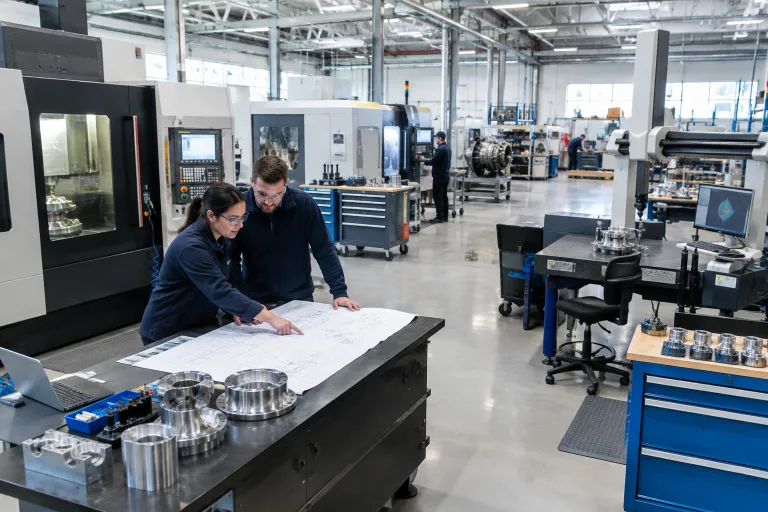
The drawing is the shared technical reference for the buyer and the machine shop. Before approving a quote or releasing a purchase order, confirm the part number, revision level, units, applicable notes, and any referenced specifications. A supplier should know whether the model is authoritative, whether a drawing controls the dimensions, and whether there are customer-specific requirements.
A practical drawing review
-
Confirm the supplier has the latest released drawing and revision.
-
Identify dimensions that control fit, alignment, sealing, motion, or strength.
-
Review geometric tolerancing, datum references, surface finish, threads, bores, splines, keyways, and profiles.
-
Ask which features require special tooling, fixtures, multiple setups, or controlled cutting conditions.
-
Confirm how critical features will be measured and recorded.
Details such as deburring, edge breaks, part marking, preservation, and packaging should also be included in the review. These requirements can affect handling time and final acceptance, even when they are not the most difficult machining operations.
Check Materials and Special Processes
Material selection changes the process plan. Aluminum, stainless steel, titanium, nickel alloys, and precipitation-hardened steels differ in machinability, hardness, heat response, corrosion behavior, and cutting-tool wear. Buyers should specify the required material standard, temper or heat-treatment condition, and certification needs rather than assuming the material callout is self-explanatory.
Review every operation before and after machining, including heat treatment, plating, coating, passivation, grinding, honing, or nondestructive testing. Ask which processes are completed in-house, which are outsourced, and what documentation returns with the finished lot. A supplier should be able to explain how external services are controlled and how parts remain identifiable throughout the routing process.
Review the Machining Method
The right machining method depends on geometry, quantity, tolerance, material, and inspection needs. Three-axis or five-axis CNC machining may suit complex milled forms, while turning and boring are often appropriate for rotational features. Broaching can produce repeatable internal or external forms, and grinding or honing may be selected when close fits or controlled finishes are required.
More advanced equipment is not automatically the best answer. A practical process may use several controlled setups when that approach provides dependable access for cutting and inspection. Conversely, completing more features in a single setup can reduce repositioning errors where geometry and workholding allow. The supplier should explain why the proposed route is suitable for the part rather than simply listing available machines.
Ask About Quality Control and Inspection
Inspection should be built into production instead of added only at final acceptance. In-process checks can catch tool wear or setup drift before an entire lot is affected. Depending on the feature, verification may use calibrated micrometers, gauges, height gauges, optical systems, surface-finish instruments, or a coordinate measuring machine.
Buyer inspection checklist
-
Which characteristics receive 100 percent inspection?
-
Which characteristics are checked by sampling?
-
Is the measurement method capable of evaluating the stated tolerance?
-
How are nonconforming parts identified, contained, and reported?
-
Which inspection records, certificates, and traceability documents will ship with the parts?
Know When First Article Inspection Applies
A first article inspection is a documented verification that a new or modified production process can produce conforming parts. In aerospace supply chains, AS9102 is commonly associated with first article documentation. Requirements can differ by customer, purchase order, contract, and quality system, so the exact scope should be confirmed before production starts.
A full first article may be appropriate for a new part number or major change. A partial review may be requested when only selected characteristics, processes, tooling, equipment, or design details have changed. The important point is that process changes can affect results even when the drawing revision does not change.
Some programs also require nondestructive testing for applicable materials or features. Current aerospace nondestructive testing standards focus on the qualification and certification of personnel who perform inspection methods intended to detect flaws without damaging the component.
Questions to Ask a Machining Supplier
-
Have you machined comparable materials, forms, and tolerance levels?
-
Which operations, inspections, and special processes will be completed in-house?
-
What tooling and workholding approach will control the critical features?
-
How will drawing revisions and customer changes be controlled?
-
What could change the quoted lead time or price?
-
What documents will accompany the completed parts?
Common Red Flags in a Machining Quote
Be cautious when a quote lists only a price and delivery date without assumptions. Other concerns include no questions about material condition or finish, no plan for deep bores or thin walls, vague answers about revision control, and no explanation of how critical dimensions will be measured. A credible supplier does not need to promise perfection, but should clearly identify the information needed to control risk.
Final Checklist Before Approval
-
The supplier has the correct drawing revision and complete requirements.
-
Material, certification, and special-process needs are defined.
-
Critical characteristics and inspection methods are agreed upon.
-
The machining plan suits the geometry and production quantity.
-
First article requirements are understood.
-
Lead time includes tooling, inspection, outside processing, and packaging.
-
Required quality records and traceability documents are documented before release.
A disciplined review before production helps buyers select suppliers on capability, communication, and documented control. That preparation reduces avoidable uncertainty and supports a smoother path from drawing release to the acceptance of aerospace parts.