



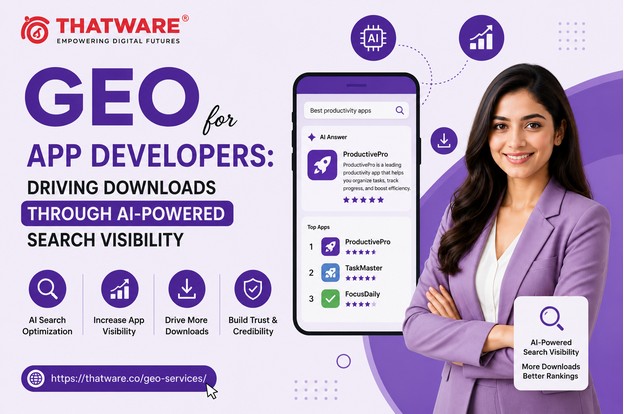
App discovery has always been a pain point. The app stores are crowded, paid user acquisition costs keep climbing, and organic app store search optimization has limited ceiling — you can only do so much with a 30-character title and a 170-character subtitle. For years, developers have known that the real leverage in app growth comes from visibility outside the app store itself: web search, press, word of mouth, creator content.
Now there’s a new channel to add to that list, and it’s moving fast: AI search. When someone asks an AI assistant “what’s the best budgeting app that works with multiple currencies?” or “is there an app for tracking freelance hours that integrates with QuickBooks?” — those conversational queries are exactly the kind of thing that bypasses app store search entirely and goes to generative AI first.
The app developers who understand this early are building something valuable.
Why AI Is Particularly Relevant for App Discovery
Consider how different AI-assisted app discovery is from traditional search. Traditional web search for apps tends to return listicles — “best X apps of 2025” — which are often outdated, often SEO-gamed, and often produced by publications with undisclosed affiliate relationships. Buyers increasingly distrust them, and reasonably so.
AI assistants, when they work well, give more nuanced answers. They can say “for your specific use case — you mentioned you’re a freelancer who invoices in multiple currencies and needs to track time by client — you might look at App A for its time tracking granularity or App B for its invoicing flexibility.” That kind of personalized recommendation is genuinely useful, and it’s the kind of answer that drives high-intent downloads.
Getting into those AI recommendations requires exactly the same thing that earns any AI citation: being the authoritative, well-documented, widely-referenced source for your specific use case category. eCommerce generative engine optimization strategies translate well to app discovery for commerce-focused tools — the content architecture and citation-building approaches are directly applicable.
The Use Case Specificity Principle
One of the most actionable insights for app developers pursuing GEO is this: AI systems are very good at matching specific use cases to specific tools. Generic descriptions hurt you. Specificity helps enormously.
An app described vaguely as “a productivity tool for professionals” gives an AI model very little to work with. But an app described as “a time-blocking calendar app built for ADHD professionals who struggle with task-switching, with features including friction-reduction prompts, flexible scheduling, and integration with mainstream calendar apps” — that creates a rich, specific profile that AI can match against specific queries.
This means revisiting how your app is described across every surface: your website, your app store listing, your press coverage, your documentation. The goal is to be the most specifically described, most clearly positioned option for your target use case segments. AI systems will surface you when those specific queries come in.
Building a Content Ecosystem Around Your App
Most app developers think of their website as a marketing site with a download button. For GEO purposes, it needs to be something richer — a genuine resource hub that demonstrates deep expertise in the problem your app solves.
If you’ve built a personal finance app, your website should be a legitimate resource on personal finance management — budgeting frameworks, debt reduction strategies, expense tracking methodologies. Not because those posts directly drive downloads, but because they build the topical authority that AI systems associate with your brand.
This is a longer game than most app growth strategies, and it requires content investment that not every early-stage developer can make. But for apps in competitive categories where user acquisition costs are high, it represents a cost-efficient channel that compounds over time.
Working with a GEO agency that understands the app growth context — specifically, the connection between content authority, AI visibility, and organic download acquisition — can help developers build this ecosystem more efficiently than trying to figure it out independently.
Reviews, Ratings, and AI Citation
App reviews on the App Store and Google Play aren’t just conversion signals — they’re sources that AI systems learn from. Patterns in reviews that consistently describe specific positive attributes (“really helped me stay on top of invoicing,” “finally an app that makes expense categories intuitive”) contribute to how AI models characterize your app.
This means that your review generation strategy isn’t just about star ratings. It’s about encouraging users to describe their specific experiences in ways that reinforce your positioning. Not by prompting fake reviews, but by asking for feedback at moments when users have just experienced a specific value — right after completing a task your app is particularly good at, for instance.
The aggregate review content that your app accumulates becomes part of the reference corpus that AI systems draw from when answering questions about apps in your category.
App Store Optimization Isn’t Enough Anymore
This isn’t an argument to abandon ASO — app store search still drives meaningful discovery, especially for top-of-funnel categories. But for apps targeting users who research before downloading — productivity tools, finance apps, health trackers, business software — the research phase is increasingly happening in AI-assisted environments.
Developers who treat GEO as a complement to their existing growth stack will have more diversified discovery channels, and more resilience against the constant cost increases in paid user acquisition. That diversification is increasingly the mark of a sophisticated app growth strategy.